

The exhibition currently on display the Museum, deals with the interrelationship between couture and machines. Such are the garments designed by Ying Gao, which are on display.
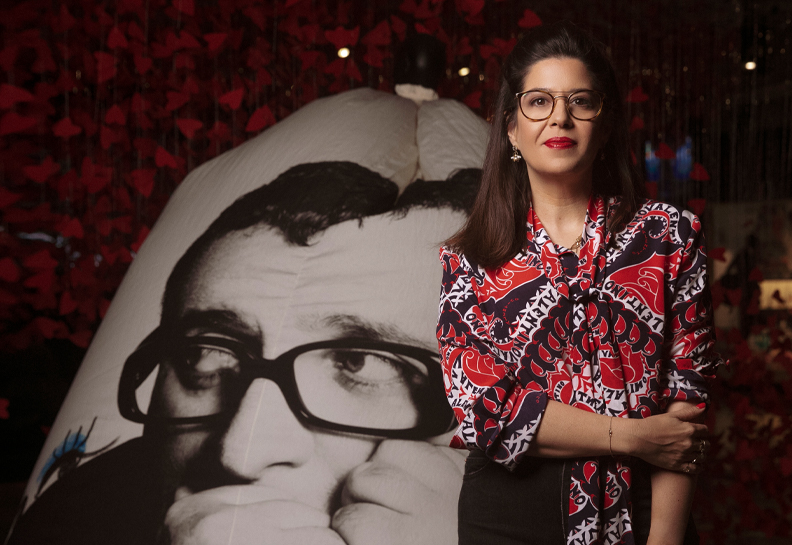
Mechanical Couture – Fashioning a New Order, deals with the interrelationship between couture and machines. The combination of these two words will generally bring to mind instant images of the huge factories evoked by the triple-word phrase “Made in China”; three words that are usually received with disdain and indignation about inferior quality, harsh working conditions, mass production, and the absence of originality. But once in a while, this combination produces different and wondrous things; garments that could not have been produced other than by means of this combination of machines and couture. Such are the garments designed by Ying Gao, which are on display in the exhibition.I met Ying Gao, whose garments take up about half the space of the Museum’s Lower Gallery, for coffee at the Museum two days before the opening of the exhibition. She was born in Beijing in 1974, her father was a diplomat, and she lived in various countries around the world. She studied fashion design in Geneva and Montreal. After working for a while in the fashion industry, she realized that this was not where she belonged, and decided to continue her studies. She was awarded her MA in Interactive Media from Université du Québec à Montréal, where she is currently a professor at the Graduate School of Fashion Design. A surprising shift, one might think, but according to Gao, there was nothing more natural for her. “I have always had a tendency for media,” she states modestly.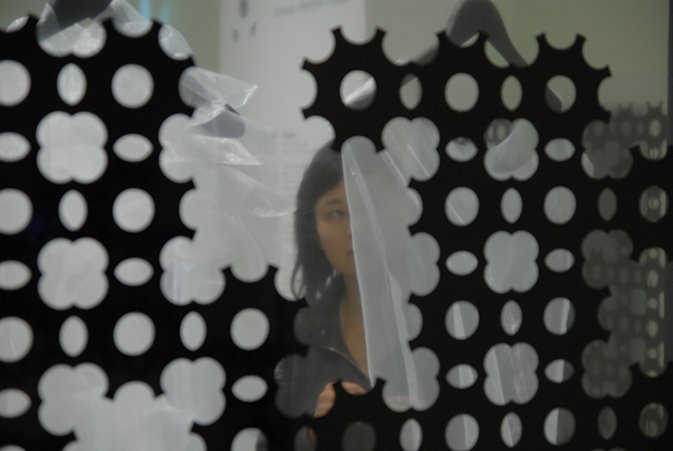 Ying Gao at Design Museum HolonWhy did you choose to study fashion design?”In my childhood in Beijing,” she recounts, “my mother took me to see a Yves Saint Laurent exhibition, and I was amazed. So I decided that I, too, wanted to create clothes that would amaze people. When I completed my studies, I started working in the fashion industry, and realized that sadly most of the fashion world is far removed from Yves Saint Laurent. Today, as a lecturer at the School of Fashion Design, I teach conceptual fashion, and with my students I place greater emphasis on the thinking, the ideas, and a powerful statement, than on fashion and trends.”
The distinctive garments you are displaying in the exhibition combine technology and fashion. Mechanisms and sensors that respond to motion, air and light in dresses with flower appliqués and pleating. There can be no doubt that the technological aspect is very important in your work, but you do not neglect the garment’s stylishness either. What inspires you to begin working on a new garment, technology or fashion?”Cinema is a total experience in every respect; it is a collection of small experiences concentrated into a whole creation that affects most of our senses. This is my attitude to the garments I create. As a whole experience, and as such it is difficult for me to separate technology from fashion, two aspects that are ingrained in me and my work. I find it boring to create something that is solely technology, and I find it boring to create something that is solely fashion, but the combination between them is what arouses my interest and inspires me to create.”You say that in the creation of your technological garments you were influenced by Jacques Tati’s film, Playtime; are there specific scenes that influenced you?”Yes. There’s one scene in the film in which Jacques Tati crashes through a plate-glass window that disintegrates and shatters into smithereens. This scene inspired me to create the airy dress made of super-organza. The translucent, shimmering fabric, and working on the garment form with origami folds, all create an effect that reminds me of that shattering glass. There’s another scene in the film in which you see the window of a modern apartment, which is very stylishly designed, and the apartment’s window looks like a store display window, and the protagonist looks into the apartment-store from the street. This scene was the inspiration for my design of the dress with the inner light.”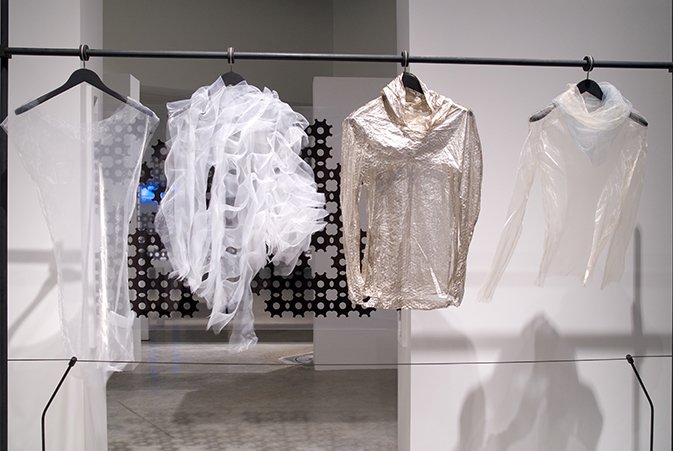 Garments From the Post-Vernissage collectionWhen I look at the groups of your garments on display in the exhibition, they seem to me like completely different worlds. On the one hand, the airy group made of super-organza, and on the other the Post-Vernissage collection made of opaque fabrics, comprising mainly winter wear. What is the relationship between these two groups?”I’ve never thought about it like that. I guess when you draw my attention to it I can understand where the thinking and the separation come from, but all the garments without the technological aspect that are displayed in the exhibition are from a single collection, Post-Vernissage. Karl (Karl Latraverse, co-designer of the Prêt-à-Porter [Ready to Wear] collection) and I don’t work according to seasons, but by inspiration, and the inspiration produces textures and different materials that sometimes seem as if they’re taken from different worlds, but they belong to a single, complete collection.”In the Post-Vernissage collection, apart from the sophisticated forms, are there any innovations that are invisible to the observer?”In the search for new materials, I arrive at experiments that sometimes produce fascinating results. One such experiment was with gauze, which is usually used for medical purposes, and due to its light weight it is also used to dress burns. I played with the fabric and tried to dye it in different ways. The most successful one, which can be seen in the exhibition itself, was to spray the fabric with silver and gold. The light and airy fabric didn’t lose any of its airiness after being dyed, and the result looks exclusive and traditional.”
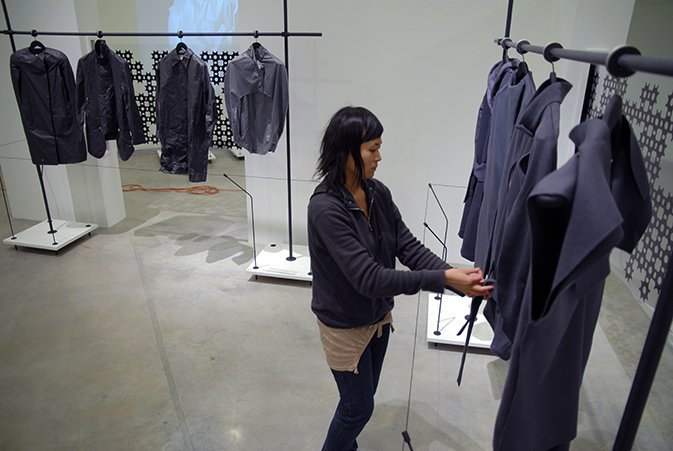 Garments From the Post-Vernissage collectionI read in an article about you that air is one of the main inspirations for your work. The fabric you use, super-organza, is without doubt one of the best-suited for this inspiration, but it can’t be found in bolts on the shelves of regular textile stores; how did you come across it?”It all started with a project I built in my head. The inspiration for it was indeed air. I wanted to create clothes that would fly, light clothes that look as if they’re floating in the air, as it they’re not affected by gravity. The plan was to use helium gas and create garments that are so light that they can lift into the air. The fabric I needed for this project had to be as light as possible. I started looking for materials that fit this definition and eventually met with a Japanese manufacturer in Tokyo. It was he who showed me and introduced me to super-organza. I came back to Canada with a whole bolt of this amazing material. Unfortunately, even the lightest fabric in the world turned out to be too heavy for helium.”Nowadays, when you want to commercialize a garment, you remove the technology from it, which remains only on the conceptual and ideational level. Do you see a situation in the future whereby the conceptual aspect will also be commercially produced?”I don’t believe we’ll see conceptual couture in the streets, at least not in the near future. One of the roles of haute couture is to amaze people and make them dream of something that’s beyond their reach. And now, when traditional couture is starting to lose it relevance, we need to think about and search for the next generation of dreams that will make people’s jaw drop in amazement. As far as I’m concerned, the mechanics I include in the garments I design are a type of couture. The mechanics are designed to create an effect of amazement and mystery in the garment, and that’s not needed in everyday life. Ultimately, commercial clothes are designed to be worn, and couture is designed to amaze and then to be archived.”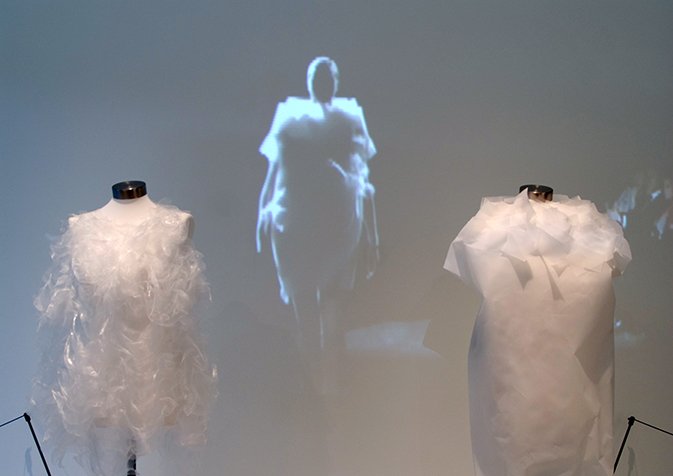
What kind of materials would you like to work with in the future?”Water. The inspiration I draw from nature and basic natural elements is very powerful. I believe we shouldn’t go looking for new materials and challenges if we haven’t yet exhausted the ones we have. And as far as I’m concerned, water is the next challenge; to try and work with organic materials in their most natural and pure state. As opposed to working with organic cotton, which is actually not entirely organic since it undergoes enhancement processes, washing, weaving, and so forth, I’d like to handle materials that come directly from nature, and that leaves me with air, light, and water. So, until I find a material that’s sufficiently light to continue my helium project, I’ll try to work with the other two.”And what next, for the next ten years?”I’d like to go on teaching. I love seeing the students’ eyes and their looks. I love seeing their desire to learn and I love the interaction with them. I often feel fortunate to be teaching, and I feel that I have the privilege of learning from them too,” says Gao, and goes on to conclude, “In order to create and innovate you need unending curiosity, always strive to know more, investigate more, and experience and experiment with as much as possible, take nothing for granted, and be as bold and daring as you possibly can.”
Gao’s works, Living Pod, Walking City, and part of the Post-Vernissage collection she created with Karl Latraverse, can bee seen at Design Museum Holon until January 8, 2011