

The Department of Jewelry Design’s graduating class presented a variety of diverse design approaches and forms of expression that allow us to examine the world of jewelry design
The Passion for MaterialDepartment of Jewelry Design at Shenkar College of Engineering and Design A review of the 2010 graduates.
What makes jewelry interesting in terms of design? And what makes it desirable?Using expensive materials is not enough, nor is precise handcrafting and attention to detail. At Shenkar’s annual graduate exhibition, the Department of Jewelry Design’s eighth graduating class (headed by artist Sharon Keren) presented a variety of diverse design approaches and forms of expression that allow us to examine the world of jewelry design from a variety of perspectives.As with any design project, we can speculate about the source of inspiration, we can trace the research into the materials, and we can certainly examine the final object and its relevance to what is happening in the world of design today.However, since jewelry oftentimes appeals to our emotions as observers or consumers, and sometimes evokes a sense of desire and yearning, it is also important to examine what it is that makes it so.So, if using expensive materials is not enough, what is? Something in the combination of materials, in the silver and goldsmithing, the tactility, the size of the object and its proportions and balance, all undoubtedly contribute. And we cannot forget the connection a piece of jewelry makes with the human body. Unlike a sculpture, a piece of jewelry is also a wearable item and mandates some kind of reference to the body. At times it also marks the body’s continuation or change.One of the prominent trends this year was the search for new materials.Only a few projects this year made exclusive use of the traditional materials we are familiar with from the world of jewelry design, such as gold, silver, and gemstones. There is a general sense that this year immense effort has been invested in stretching the boundaries of the materials comprising the jewelry designer’s world.The search for new materials is not always a successful one, and at times the final product merely looks like an opportunity to experience the material.So, when is it successful?When the designer brings with him the tools from his world, like skilled silver and goldsmithing, precise handcrafting, and attention to the small but most important, details, such as connectors.Add to all these qualities the choice to use a different material that comes from a different content world, and the results are intriguing and extraordinary combinations. This is an elusive moment that is difficult to accurately define, in which something new is created.An example of this kind of combination can be seen in the work of Dikla Rosen. The project, entitled “8.5/5.5”, is influenced by impaired eyesight, a sense of eyes darting, seeing through a softened lens, and the transition between clarity and haziness. The technique used to produce the pieces comprises reproducing small, delicate elements, cast silver and brass, and mounting tiny feathers that have undergone a dye and comb process.
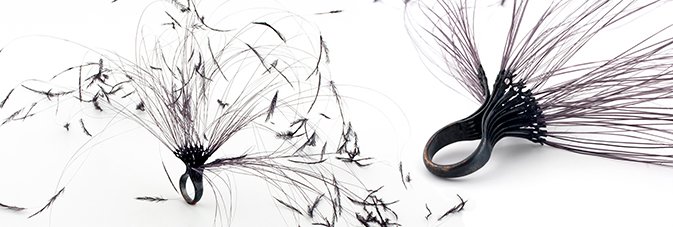 Jewelry Design at Shenkar College of Engineering and Design | Dikla Rozen
The final pieces include sculptures or “table objects”, and jewelry-cum-sculptures that definitely meet the criteria for jewelry, evoking a sense of yeaning in the viewer. The delicateness of the fine feathers, their repetitiveness and movement create motion and drama.In this work, as in others, we can see a direct connection with what is happening in today’s fashion world. Many designers are rediscovering feathers as a raw material for creating garments and accessories. The feathers convey a sense of freedom, lightness, movement, and buoyancy, and perhaps symbolize our desire to fly like a bird.
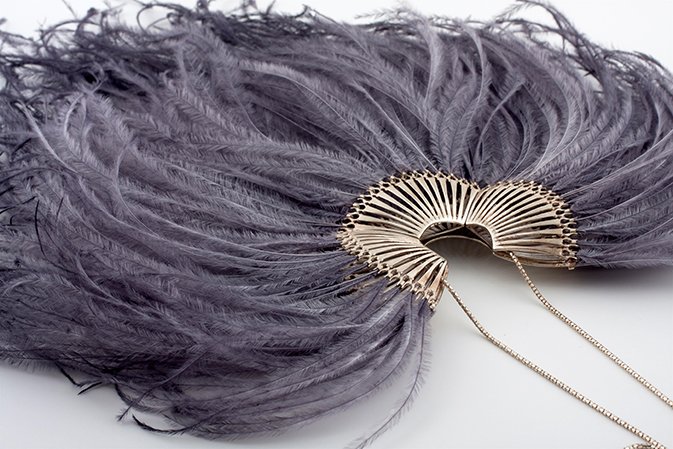 Jewelry Design at Shenkar College of Engineering and Design | Dikla RozenAnother project in which interesting use is made of unconventional material is Shiri Avda’s project, entitled “Perhaps It Never Happened”. The pieces in this collection look like a new geographic mapping of a distant and imaginary world. Old encyclopedias, atlases, and fairytale and travel books serve both as the designer’s source of inspiration, and the raw material itself. It is interesting to see how in her hands pages from a book are transformed into something new, at times one-dimensional and at others three-dimensional. The colorfulness of the pieces also derives from the pages of the original books.
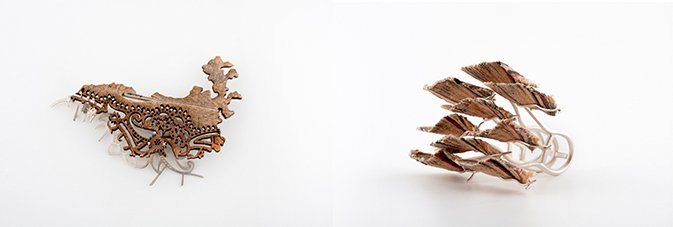 Jewelry Design at Shenkar College of Engineering and Design | Shiri AvdaMost of the prestige jewelry designed by Yarin Bylica, entitled “Furry Tales”, is made of fur that he collected and recycled from vintage garments. The pieces express an interesting meeting point between animal fur as a raw material and classical silver and goldsmithing. We can see how the designer endeavors to control the hard-to-control material (fur) with means from the world of silver and goldsmithing, and creates a romantic look from bygone days, when fur was a symbol of the upper classes in conservative society. Yet, there is something a little aggressive in these pieces, perhaps attesting to the fact that they were made by a male and not a female designer.
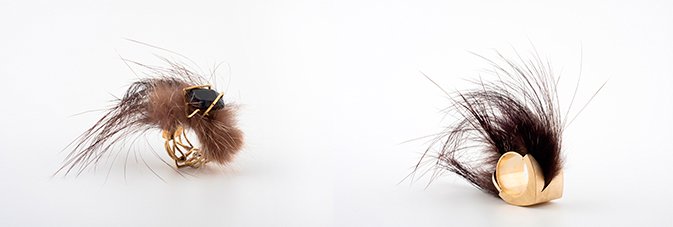 Jewelry Design at Shenkar College of Engineering and Design | Yarin BylicaIn Chanan Kedmi’s project, too, entitled “Felt Follows Form”, the male designer’s touch is evident. In this project two materials from two different worlds are combined: tiny aluminum parts (which were taken from the innards of a computer) and felted wool. Work with felt is reminiscent of traditional women’s work in the past and generally evokes associations of softness and warmth. In this instance, the designer discovered and exploited a different characteristic of the material – the possibility of constituting a connecting factor. The felt binds the metal parts, and not only contains them, but is also set within them.
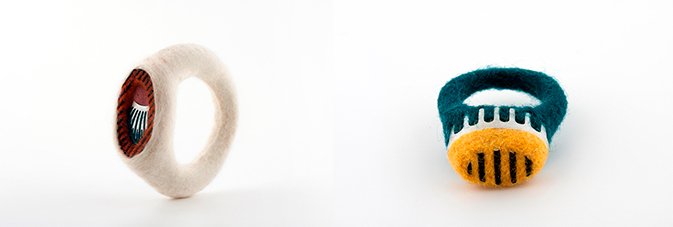 Jewelry Design at Shenkar College of Engineering and Design | Chanan KedmiNext to Tal Baruch’s work is the sketchbook that accompanied her throughout her project, entitled “My Past, My Present”. The book contains beautiful drawings that combine drawn lines with sewn or embroidered ones. The source for the drawings and for the entire project is old childhood photographs. The pieces are made using a technique combining classical silver and goldsmithing, finely crocheted threads, and fabric cast in metal. The threads acquire a faded sepia color and blend with the hues of the corroded metal. The knitted line winds around and surrounds all the details, including set stones, and resembles the outline in the initial sketches. It is interesting to see the details and developments and textures in the material upon closer scrutiny.
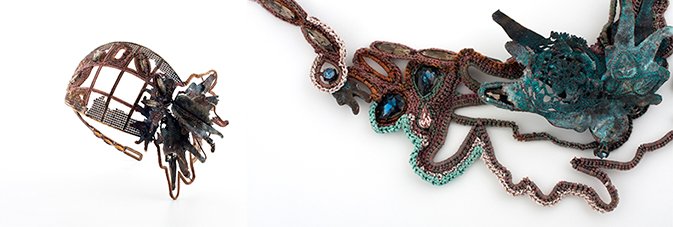 Jewelry Design at Shenkar College of Engineering and Design | Tal BaruchPreoccupation with material, creating through it and by means of it, also typified the works of graduates who did choose to remain with the traditional materials of the jewelry world. A fine example of a project entirely built from preoccupation with material is Shani Maor’s “Silver By Chance”. The designer returns to silver as her primary raw material and draws the shapes of her delicate pieces from the basic processes of working it: smelting and beating. The work with the material defines the final form of the piece of jewelry and enables the designer to create random and uncontrollable shapes. In this project skillful use has been made of enamels that organically blend with the silver and do not overpower it. It is interesting to look at the pieces and see the tension created between the spontaneity and randomness of the process and the final piece of jewelry that looks skillfully and accurately crafted.
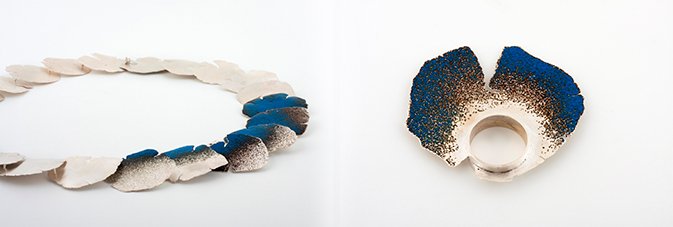 Jewelry Design at Shenkar College of Engineering and Design | Shani Maor
One way or another, the projects presented at the graduate exhibition attest to the fact that the Department of Jewelry Design not only enables a diverse and surprising variety of design approaches and different means of expression – traditional silver and goldsmithing methods alongside more industrial pieces – but also encourages a search for and use of new and unconventional materials in the sphere of jewelry design.Nevertheless, it is evident that there is no substitute for the designer’s skills as a craftsman, as a silver and goldsmith. The best projects are those that combine surprising materials with handcrafting to create pieces of jewelry that are works of art in their own right.