

The term “vision” is usually used to refer to a physiological process involving both the eye and the mind. Although its scientific study has given rise to various theories and findings, the subject of research – vision itself – has not changed or developed. One can well assume that the makeup of the human eye is identical to its makeup one hundred or one thousand years ago. By contrast, the discourse on observation and the gaze studies the ways in which the natural phenomenon of vision is organized and understood. Observation is not a primal, natural, universal activity, but rather onethat is culturally constructed. Just as every culture constructs subjectivity through its concern with gender and sexuality, aggression, family structure, childhood, or old age – so it structures the human gaze.
Like culture, the gaze too has a history. Culture defines us, and just as it dictates how and what we must think and feel in various situations, so it dictates how and what to observe, as well as how to organize our perceptions and endow them with meaning. For instance, when we watch contemporary video clips or films, we are neither shocked nor surprised by the fragmented, rapidly changing images. Yet it is difficult to imagine how members of previous generations would have perceived today’s fragmented films. One may hypothesize that they would have been disturbed, even frightened. For contemporary viewers, this form of fragmentation is far from threatening; we are similarly comfortable with passages between blackand-white and color images, or between illustrations and computer-generated simulations. Indeed, we have almost ceased to note whether the pictures we see on television, in advertisements, or at the movies are photographs of things “that exist in reality” or some form of simulation. In other words, we hardly bother to translate the picture, or signifier, into something that exists out there, into a signified (in stark contrast to the original function of realist representation, which sought to convince the viewer that the signified was real). We accept this form of detachment as a given.
Video clips, television, and films are shaped by a perception of time and space and by a relationship between signifier and signified that is different than our everyday perceptions, as if the picture existed independently and contained information that did not relate to the world surrounding it.
It is obvious that such exposure to fragmented images and to a combination of photography and simulation shapes the viewer. Yet fragmentation and simulation shape not only our modes of observation, but our entire worldview. Famine in Somalia horrifies us because the pictures are horrible, not because it is actually taking place, and our discomfort dissipates when the image changes. We ourselves become fragmented and discontinuous, entertaining only a weak connection to reality. The picture thus becomes, even if not always consciously, a tool that shapes worldviews and a means of political control, which keeps the viewers glued to the screen rather than attentive to the reality unfolding beyond it.
These familiar examples may create the impression that the construction of the viewer by means of the image is a new phenomenon. Many would indeed argue that vision today has a more central cultural position than ever before, and that we live in a visual, oculocentric age in which pictures shape our consciousness. Yet the construction of observation in a cultural context is not a new phenomenon. I will now turn to discuss one example from the Middle Ages, and a second example from the transitional period between late medieval and Renaissance culture. In the Middle Ages, the distinction between terrestrial, everyday, secular light (lumens) and light as divine revelation (lux) was assimilated into language and familiar to all, not only to educated people. Light inside the church or cathedral was perceived as lux, and as essentially different from regular light. The stained glass windows that illuminate the cathedral with colorful light gave expression to this perception, and were viewed as transforming light into a religious metaphor and experience.
Theological discussions of light have a history of their own. So, for instance, the transition from the colored glass windows of the Catholic church to the transparent windows of the Protestant church involved a parallel shift in the theological conception of the color of divine light, and in the conception of the relationship between the heavenly and earthly realms. Later on, with the development of realism in painting, the same question arose once again: Was the light in the painting divine or earthly? Many Renaissance paintings combine secular and religious scenes, raising questions about the quality of the light.
One solution was the presentation of two different sources of light in a single painting. So, for instance, in Piero della Francesca’s painting Flagellation of Christ (1455-1460), the secular scene to the right is lit with white sunlight, which shines from the upper left side. The religious scene on the left, by contrast, is illuminated by soft, golden light that falls upon it from an invisible source to the right. The painting contains two types of light and two orders of reality.Two hundred years later, Rembrandt further developed the use of two sources of light: this time the difference is not in their colors, but rather in their location in the foreground or depth of the painting. The secular light in the foreground underscores the flesh, while the deeper and more spiritual light endows the figures with haloes. Once again, it is important to emphasize that vision itself did not change. The eye perceives the two sources of light just as they were perceived by Piero or Rembrandt’s contemporaries – yet its meaning has changed.
The gaze is shaped as a language, a culturally specific system of signs. In Jacques Lacan’s terms, we could say that a screen of signs separates the eye from the world, and that the eye does not see the world, but rather the screen. There is a fundamental gap between the real and the meaning we assign to it. The meanings are inscribed on the screen. They are not part of the world, nor are they the viewer’s unique creation. The organization of perception, the schema that shapes our gaze, is the filter through which we see the world.
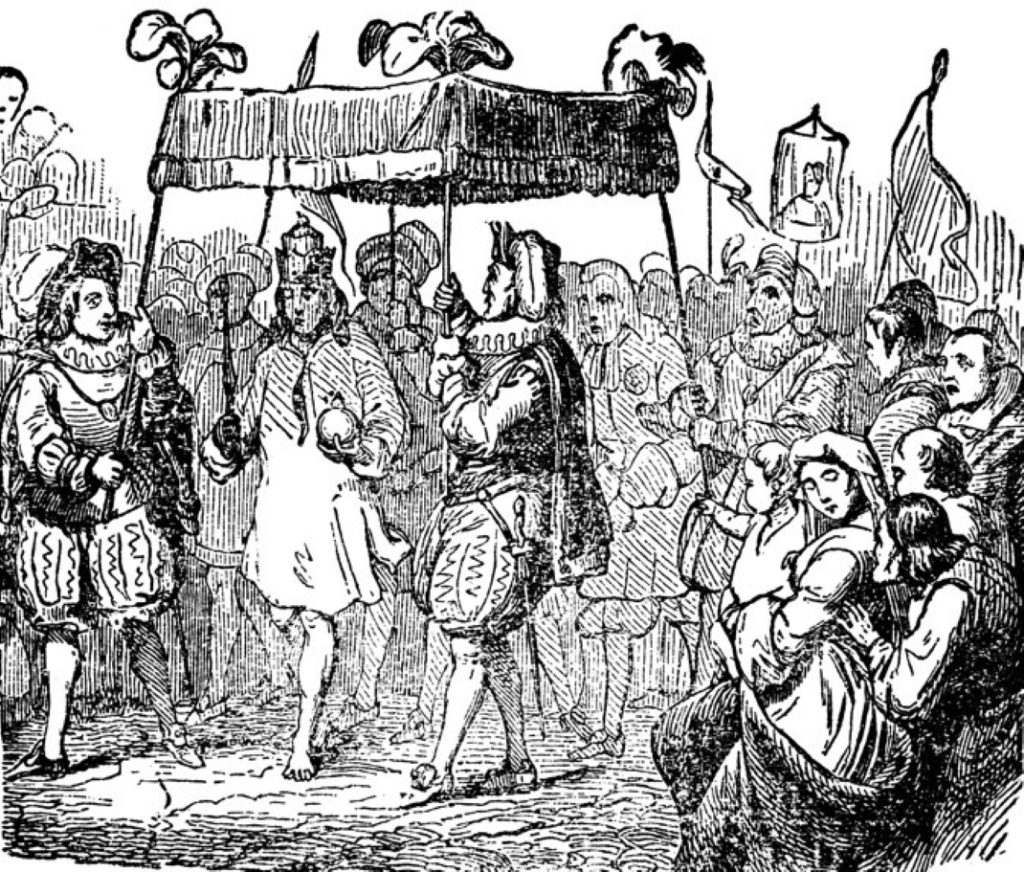
Lacan exemplifies the existence of this filter or screen through his interpretation of the story about the Emperor’s New Clothes. The emperor marched naked before his people, and nobody saw or said a thing until a small child cried out that the emperor was naked. How could that be possible? The physiology of sight enabled everyone to see the same thing, yet the viewers were separated from the emperor by a screen of (false) meanings, which camouflaged his nudity. The viewers did not see the actual nudity, but rather the screen on which the meaning of nudity is the stupidity (or nudity) of the viewer. The viewers, one could say, were imprisoned by their own blindness, as every observer of the world is imprisoned. The dividing screen lies to us, blinds us, and deludes us into thinking that we are truly seeing the world, when in fact all we see are the meanings predefined by language.
This approach to the history of observation has tremendous implications for art history and criticism. Art history, as it evolved from Giorgio Vasari to Ernst Gombrich, is the history of a form or style: art is perceived as an independent field whose history is selfdetermined, every style emerging in relation to earlier styles, which are all tied together by the pure visual experience at their center. Gombrich, for instance, endowed “pure vision” with a central role: the artist paints according to a schema, according to what he knows, and then observes the painting and the model to compare and correct the painting so that it will more closely resemble what is perceived.
In the late nineteenth century, the oculocentric approach, which puts vision at the center, came to dominate not only art history but also criticism – as evident in the writings of critics such as John Ruskin, Roger Fry, and Clive Bell, who defined the tools of formalist criticism centered on “meaningful form.” Formalism has accompanied us since the inception of modernism, reaching its most radical formulation in the writings of Clement Greenberg, who sought to define a language of painting that would concern itself solely with the medium’s essential qualities – a form of painting that is stripped of all narrative elements and appeals to vision alone. Terms such as “meaningfulform,” “innocent eye,” or “the purity of vision and visual language” assume, in contrast to Lacan’s position, that meaning is not constructed by its cultural context but is rather assimilated into the form and directly perceived by means of vision. There is no distinction between vision and observation as art attempts to capture a universal essence beyond a unique cultural context.
The distinction between vision and observation has only recently filtered into the discourse on art. Martin Jay provides some notes for a history of observation, or what he calls “scopic regimes,” by distinguishing between the three central regimes that led to the construction of modern observation.The first regime, “Cartesian perspectivism,” originated in the formulation of perspective by FilippoBrunelleschi and Leon Battista Alberti during the Italian Renaissance, yet the worldview it represents achieved its most radial and succinct definition in the philosophy of René Descartes. Perspective is usually perceived, on the most superficial level, as a technical tool for representing space that is employed in realist painting. This view implicitly assumes that perspective is an objective tool for representation that has no ideological underpinnings or thrust to control and design expereince. Yet further investigation reveals that beyond its role as a technical tool, perspective symbolizes harmony between the objective mathematical laws of optics and the human gaze capable of grasping this world order. The viewer is located at an ideal point, across from the perspectival vanishing point. Reality is captured from a certain angle, so that the painting, too, is best viewed from a certain position. It is important to note that the “viewer,” in this case, is not a wandering body or gaze – but rather a stable, immobile eye. Both the movement in the represented world and the viewer’s movement have been frozen, and both the painting and the act of observing it lack a temporal dimension. The eye peers at the world, interprets it and understands it perfectly (in Lacanian terms, we could speak about the phallic gaze that freezes and overtakes the object). This ideal eye is detached from the body and from personal emotions and needs. The gaze and the act of representation are perceived as a neutral scientific process unrelated to subjectivity or desire; the subject is detached from the object, and observes it without attempting to bridge the distance between them.In turning to define the second visual regime, Jay builds on Svetlana Alpers’ discussion of “the art of describing,” which centers on seventeenth-century Dutch painting. Alpers points out that Italian painting, despite the formalist abstraction of perspective, always relies on a (religious, mythological, or historical) text, and is thus inherently narrative. Dutch painting, by contrast, describes the surface of the world – an expanse structured by no clear hierarchy, no religious or moral meaning, and no logical organization.
The world precedes the viewer. It is indifferent to her, and exists equally in her absence. It is not ordered into a perfect composition that is compatible with the painting’s frame or the location of the viewer’s eye. In some instances the frame randomly crops the image of the world, which continues to extend out beyond it. As is the case with a geographical map, descriptive painting does not assume the presence of an ideal point of view, and there is no control of the viewer’s location or perspective. The gaze can draw closer or farther away, focus or wander off. The world is a fascinating, empirical, detailed surface filled with reflections of light and various materials and textures, which the painting does not describe but rather depicts in a seemingly reliable manner.The third visual regime discussed by Martin Jay concerns Baroque art. This regime lays an emphasis on irregularity, flexible rules, the strange and the unusual, open and continuous movement, and multiple directions (in contrast to the geometric order, uniformity, and stability of the Cartesian world). The argument assimilated into Baroque art is that the world cannot be fully and continuously read and interpreted by means of the painting, nor even reliably described. Rather, the painting is a sort of distorted mirror reflecting a distorted world that could also have been represented and reflected in other ways. In this sense, the Baroque consciousness is the first instance of self reflexivity in painting, of an awareness of representational tools as carriers of meaning, and of an acceptance of the arbitrary, ephemeral, and random dimensions of representation; the Baroque aesthetic recognizes the rhetoric of observation, the connection between visual images and words, and the limits of representation. This aesthetic also reintroduces the body into the picture – the represented body as well as the bodies and actions of the painter and viewer. The painting contains materiality, desire, sexuality and various urges – replacing the objective, detached gazewith the textured “body of the world,” which includes both the painting and the viewer.There is no longer a sharp distinction between subject and object, but rather “an ecstasy of seeing” – different relationships between desire and language, changing distances and blurred boundaries between subject and object. Baroque vision is not pure, and the eye is not disembodied and detached from movement and desire.The Baroque awareness of the limits of representation also led to the conception of the sublime as what lies beyond these limits – a concept that continued to develop in Romantic and modernist painting, which moved increasingly from a concern with the beautiful to a preoccupation with the sublime, with what cannot be understood or described. The more “physical aspects” of Baroque art were underappreciated under the reign of modernism. Today, while the two first regimes are highly criticized, the Baroque regime has enjoyed renewed appreciation, and has often been compared to postmodern approaches. The emphasis is not only on the body and on desire, but also on the Baroque’s blurring of consciousness and thought, on the awareness of painting’s suggestive and manipulative power, on the rhetoric of ecstasy, and on the rupturing of existing frameworks.The current discussion does not focus on the Italian Renaissance, on seventeenth-century Dutch painting, and on Baroque art as styles, but rather on visual regimes – on activities of organized observation that is not purely visual, but rather part of a larger worldview given expression in multiple realms. This ordered activity is not merely expressive of the spirit of the time, but is also a tool for shaping consciousness and cognition and for constructing subjectivity. Painting tells us who we are and which world we live in, what stands between us and the surrounding reality, and whether we can control it or are carried away by it. It tells us what is worthy of observation, what has value, and where we are located in relation to that field of value. In other words, a painting is a lexicon of meanings; we do not observe the painting and “discover meaning in it,” as if we lead an objective, universal existence outside of history; rather, we are compelled to discover certain meanings and prevented from discovering others.In order to highlight this point, I would like to rely on Jonathan Crary’s discussion of the construction of the modern observer, and especially on the section devoted to the history of the camera obscura. Crary’s Techniques of the Observer, which is almost entirely concerned with the history of photography, begins with an inevitable chapter about the camera obscura. This apparatus was already known in the ancient world, but it was only in the sixteenth century that it developed as a tool for drawing under the perspectival regime of observation. It was viewed as a tool for the objective representation of the world, for the translation of three-dimensional space onto a two-dimensional surface. When historical accounts present a continuum extending from Albrecht Dürer’s camera obscura to that of Jan Vermeer and on to the camera, they create a narrative of continuity, which is implicitly also a narrative concerning the objective representation of the world and an opticalscientific form of vision detached from any ideological, historical, or cultural context. Crary undermines this semblance of a historical continuum, revealing how the camera obscura served different purposes in the context of different worldviews. Not only is there no absolute, objective, ideologically neutral model of vision, but the very argument about such a model is an ideological argument.In the seventeenth and eighteenth centuries, the camera obscura was not only a neutral tool, but also part of a dominant worldview that maintained a sharp distinction between the exterior world and human subjectivity. The world was seemingly reflected in consciousness just as the picture was cast into the dark chamber. This dark chamber served as an allegory for consciousness, while the pictures reflected on its dark interior paralleled our mental representations of the world. According to this conception, the viewer does not directly observe the world, but rather its internal representations in his consciousness. This understanding distinguishes between an external world populated by objects and an internal world filled with their faithful representations. In this model the eye, like the camera obscura, operates according to optical, mathematical, scientific and objective principles, which are detached from subjective needs, desires, and experiences. In the early nineteenth century, a revolution occurred in the study of vision. Vision ceased to be perceived as a pure optical experience, and came to be understood as the product of physiological activity. The physiological study of vision was concerned with phenomena such as after-images and binocular vision; science discovered the yellow spot and the blind spot, the differences between central and peripheral vision, and studied the movements of the eye, its limits in perceiving movement, and the speed of information transmitted by the nervous system. The study of vision was also concerned with optical illusions, with the ways in which the eye is deceived, and with mechanisms of vision that create uniform, fixed perceptions.Physiology discovered that the world captured by the eye was processed in various ways, and that information was translated into electric activity. Scientists came to understand that the eye was not always reliable and did not reflect the world in an optical, direct, and transparent manner, but rather deconstructed, processed, and encoded it according to physiological rules and limitations. From that moment on, vision ceased to be perceived as a faithful representation of the world, and came to be viewed as the creator of a somewhat tendentious image of the world. In addition, the nineteenth century discovered that the camera obscura model of a single, disembodied eye does not reflect the perceptual process of two eyes connected to the body, which move and observe a moving world; the distinction between interior and exterior, subject and world, ceased to be sharp and total; and consciousness came to be understood as creating the world rather than reflecting a world that exists a priori. These understandings gave rise to the possibility of different perceptions of reality, and to a view of physiology as a dynamic parameter shaped by human needs.Despite the continuous use of the camera obscura as a technical tool, this historical moment – the period between 1830 and 1850 – marked a rupture between two different conceptions of the relationship between subjectivity and world, which paralleled the invention of photography. Photography is based on the camera obscura, yet it no longer is an ideological tool descriptive and constructive of individual subjectivity. Rather than assuming a historical continuity between the seventeenth-century camera obscura and modern photography, we must thus expose the chasm that separates them. For the camera is not a model of subjectivity but rather of indifference, of detachment from both subjectivity and meaning. I would now like to return to my point of departure that of contributing some notes to the evolving discourse on vision and the gaze. As already noted, observation is increasingly studied as a cultural construction. The discussion of the perspectival, descriptive, and Baroque visual regimes, as well as the discussion of the history of the camera obscura, were not merely offered as an attempt to rewrite history, but above all were intended to lead to a discussion of the modernist regime of vision, so that we may go on to attempt an understanding of the postmodern regime of the present.Postmodernism, a term that denotes what comes “after,” cannot and does not want to be identified with any of the earlier regimes of vision, yet it must study them in order to understand what came before it and what it does not want to be. In other words, the study of the past provides us with self-awareness – with a recognition of the rules that shape our gaze and a discovery of the screen of meaning separating us from the world; critical history will enable us, like the child in the story ofthe emperor’s new clothes, to resist the powers structuring our gaze. Postmodernism is pervaded by political critical thinking designed to dismantle the ideological visual regime that controls us.The political dimension of the gaze has been discussed by Jean-Paul Sartre, Michel Foucault, John Berger, Fredric Jameson, Pierre Bourdieu, and others, and is largely parallel to the philosophicalanthropological discourse building on the writings of Roland Barthes, Jacques Derrida, Gilles Deleuze, Félix Guattari, and additional figures. This discourse focuses, among other things, on the deconstruction of fixed concepts and images, and on the exposure of splits and internal contradictions within seemingly rational and continuous models of thought.In addition to political, anthropological, and philosophical critiques, the gaze may be addressed through the prism of Lacanian psychoanalysis and the feminist criticism that developed in its wake. Lacan argued that the gaze is organized and structured according to the pattern of male urges and desires – as are the picture, the image, language, and the chain of signifiers. The observation of art is thus not organized exclusively by visual regimes such as perspectivism, the art of describing, or the Baroque aesthetic, nor is it shaped solely by models such as the disembodied camera obscura versus the physiological eye. Rather, it is also dominated by a model of masculinity that controls language and the definition of meaning, in opposition to a mute model of femininity. The discourse on the gaze, as I perceive it, also has emotional layers. There is a pessimistic, traumatic, tragic, or paranoid layer, as well as one that is optimistic and at times also utopian, hedonistic, or comic. Pessimism stems from the discovery that we always observe the world through filters and that predetermined screens composed of words, images, schemas and meanings separate us from the real. We are constructed around blindness, splitting, and alienation. For centuries, the gaze was understood as highly reliable, and the account of an eye witness was privileged over any other account. Even when we realized that words could lie, that hearing was imperfect, that our sense of smell was atrophied, that taste was incommunicable, and that touch was distorted by desire, the eye continued to be viewed as a portal opening onto Truth. Then came the critique of the gaze and undermined this last channel of communication. Whereas critical discourse alludes to the possibility of a more just society as a means of escaping dictatorial regimes of vision, psychoanalytic discourse suggests renouncing the illusion of knowledge and embracing the anxiety involved in not knowing. Psychoanalytic thought proposes a sort of “ongoing revolution,” a continuous dynamic process of removing screens and defining meanings that are similarly transformed into a screen, and vice versa. The blind spot will continue to exist, but so will the creative and critical discourse evolving around it, and this is where we reach the optimistic dimension. Critical thinking is characterized by an ideal of freedom, so that the ongoing critical and analytic process is not necessarily a Sisyphean form of suffering. Critical thinking also contains a playful dimension, as well as an anarchist pleasure taken in breaking the rules of the game. At times the critical game becomes a comical act as we observe ourselves with the same seriousness with which we observe the world, with a gaze that observes both the world and our own seriousness. Sometimes this seriousness is our prison. Sometimes this seriousness, the honest desire to see the real beyond the screen, is itself the blind sport. Seriousness is the screen itself. AFTERWORDWhen the exhibition team asked my permission to include a lecture I gave in 1992 in the current exhibition catalogue, I had some reservations about republishing this text. The lecture was written in a context that seemed to me to have perhaps become obsolete and irrelevant. At that time, there was still hardly any recognition that the discourse on art had undergone a radical transformation from a self-reflexive, largely formalist discourse to a critical-historical discourse underscoring the cultural construction of artistic values. The understanding that the discourse on art – which had long existed autonomously in self-imposed detachment from other discursive fields – had lost its privileged position to become integrated into the larger discourse of cultural criticism was quite dramatic. The exhibition “Overview” offers an opportunity to ask whether this radical transformation has indeed been internalized. If I were writing this article today, I would perhaps write it differently (indeed, several paragraphs that seemed to me to have completely lost their relevance were omitted from this republished version).And if I were to write this article again especially for this catalogue, which focuses on Claude Samuel’s eyewear collection, I would attempt to relate these two fields to one another. Instead, I will offer a number of brief thoughts. In a series of psychological experiments, a miniscule sensor was inserted into the nozzle of a pacifier. The sensor responded to the baby’s sucking rhythm and controlled an image projected to its eyes. The experiment revealed that infants that were only several weeks old quickly learned how to focus the image by altering their sucking rhythm. Other experiments have revealed that babies prefer horizontal symmetry to vertical symmetry or a-symmetry, and that they prefer images of a human face to any other type of image. In addition to an appreciation for the methodology of this experiment, one cannot but express admiration for the infant’s ability to control its sucking in order to select and focus a preferred image. Yet among other questions, one cannot help but ask the following one: How does a newborn baby know that the world is supposed to be in focus? How does it know that the world is constructed of objects whose outlines are sharp rather than blurred? There is obviously some innate schema, or pre-conception, of a world in which there is focus. Like the universal generative grammar of speech, there is also a generative grammar of vision. And this is where we arrive at the role of eyeglasses, which correct vision impairments and present us with a corrected view of the world. According to this definition, the infant could in fact hypothetically equip itself with corrective eyewear if this were necessary.My original article created a clear distinction between vision and the gaze, while focusing on the latter’s cultural dimension. Today, I would have put more emphasis on the innate structure of vision, and not only on its cultural construction, since any construction relies on raw visual material; and as it turns out, this material is not entirely raw and chaotic. In addition to focus, moreover, our sense of direction (vertical, horizontal, diagonal), response to color or texture, distinction between figure and ground, and many additional elements of perception similarly precede any form of cultural construction, while having a structure of their own. In the current context, I would contrast the discussion of the cultural construction of the gaze with a discussion of vision, which has a physiological basis yet also involves an initial process of construction. It is thus preferable to speak of an interaction between two types or levels of the gaze: such a discussion still relies on formalism, yet no longer as a supreme value but rather as one element of the discourse on the gaze, which both complements and opposes the notion of cultural construction.To give but one example, there is no meaning to the dissolving outlines of Mark Rothko’s paintings without the viewer’s a-priori expectation of sharp outlines. Similarly, the Romantic convention of blurring is meaningful because it frustrates our expectation of objects with clearly circumscribed boundaries. In order to “get out of focus,” one must first possess the concept of focus. Optometrists, as is well known, are responsible for focus – while artists, such as Rothko, work to disrupt it.* This article is based on a lecture delivered at the conference “Vision and Blindness,”, Bezalel Academy of Arts and Design, Jerusalem, on December 15, 1992. It was first published in Studio magazine No. 43, May 1993, and was updated in 2016 for this exhibition catalogue.
Itamar Levi, PhD, studied psychology and philosophy and trained as a psychoanalyst while also working as an art critic and curator. His book The Home and the Road (2012, in Hebrew) is concerned with the visual imagination. He is currently working on a new book that centers on desire and the gaze and is concerned with the intersection of art and psychoanalysis.