

The graduate exhibitions are now coming to an end, hundreds of projects presented at the different schools of design, exposing the people who will become the designers of tomorrow.
The graduate exhibitions are now coming to an end, hundreds of projects presented at the different schools of design, exposing the people who will go on to become the designers of tomorrow. In most cases the exhibitions are shown according to department: graphic design, industrial design, fashion design, and so forth, with each department showing in rooms, on floors, or spaces of its own.During their graduation year most students live in a detached world, and their main communication is with their workspace colleagues. It is as though the walls of this space block out all external noise. They might talk to other students from their department, or with their project supervisors, but there is no doubt that contact between them and students from other departments is minimal, and contact with students from other design schools verge on the impossible.With this in mind, it is fascinating to see that despite having no direct contact with each other, or sharing supervisors, and generally no geographical contact either, one of the “gut feelings” this year was weaving techniques. The word “weave” seemingly relates directly to textile and fashion design. But unlike previous years, this technique has not remained within the boundaries of those departments, but has also filtered through to other departments at various schools. This is neither sophisticated nor innovative weaving, but rather the traditional weaving principle of threads or strips interlacing with or leaning against each other to create a new, single surface.Rami Tareef, a graduate of the Department of Industrial Design at Bezalel Academy of Arts and Design, is one of the graduates who chose to work with weaving. He began his project in the Old City of Jerusalem, where he drew inspiration from rope-weaving artists. Tareef presents a collection of accurately colored chairs that lean on the connection between art, craftsmanship, and design. The chair frames are minimalist, angular, industrial, and modern, over which Tareef has used a traditional technique to weave a net of colorful cords. The result of the connection that retains the values of craftsmanship on the one hand, but looks to the future on the other, is esthetic, modern, and desirable.
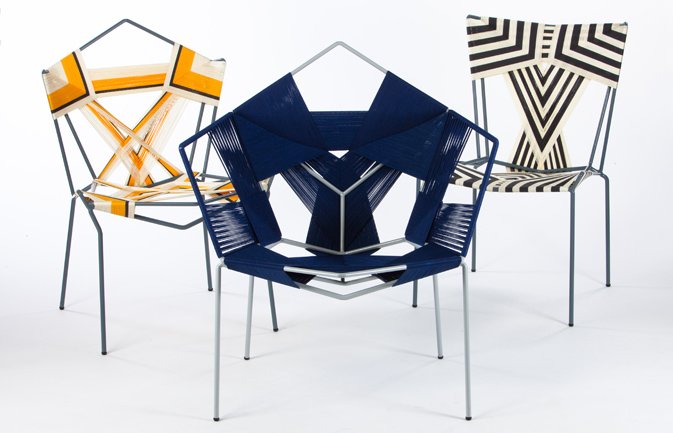 Rami Tareef, COD – Crafts Oriented Design
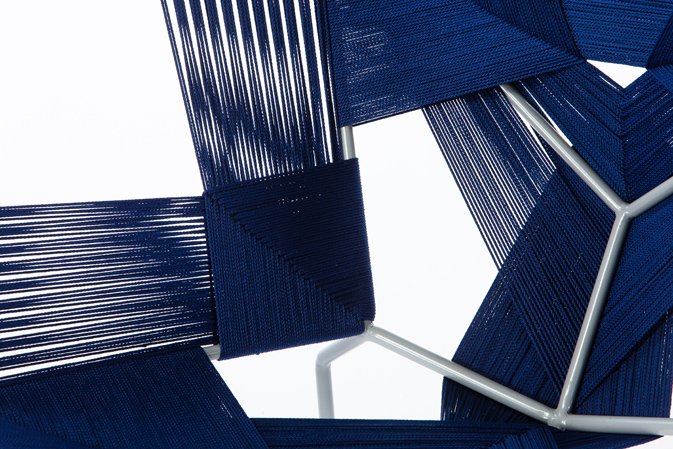 Rami Tareef, detail of COD – Crafts Oriented Design
Another graduate who employs weaving and a very similar color palette is Mark Goldenberg from the Department of Fashion Design at Shenkar College of Engineering and Design. Goldenberg presented a delicate and fascinating collection inspired by artist Naum Gabo (click here for further information about the artist), entitled Woven Bird, for which he received the DVF Award for Best Collection, and won an internship at the New York City studio of Diane von Furstenberg.
 Mark Goldenberg’s full Woven Bird collection at the annual Shenkar Graduates Fashion Show | Photograph: Kobi Bahar
It is no coincidence that Goldenberg decided to name his collection Woven Bird. All the garments are woven, some by hand over delicate wire constructions, some on a home loom, and some crudely woven strips of fabric over “bones” (these “bones” are a familiar feature in the world of corsetry, where they create the rigid structure of the corset, while here they have been given a much lighter interpretation). The sensitivity Goldenberg displays in his weaving over wire structures, alongside the refined crudeness of the “bone” strips, create a different and striking result. Goldenberg’s collection is cohesive in every respect, with each garment leaning on and supporting its predecessor and alluding to what’s to come without being predictable.
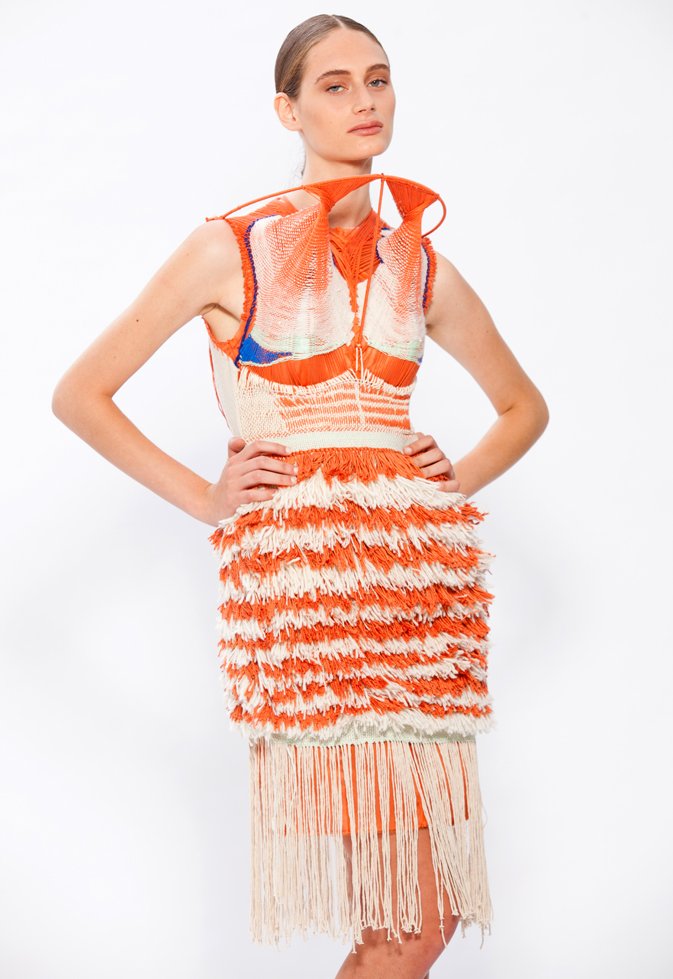 From the Woven Bird Collection, Mark Goldenberg | Photograph: Ron Kedmi
 From the Woven Bird Collection, Mark Goldenberg | Photograph: Ron Kedmi
 Detail from Woven BirdAnother striking project that makes use of porcelain strips is Beats by Ayala Sol Friedman, a graduate of the Department of Ceramic and Glass Design at Bezalel Academy of Arts and Design. In this project, as in Goldenberg’s, it is difficult to identify the material and how it has attained its erupting form. Sol Friedman uses colored porcelain strips of varying thickness. After creating very thin porcelain sheets, she cut it into strips, which at first glance look like strips of paper. She then joined these strips together and fired them at a high temperature in a kiln. The exposure to the very high temperature made these strips “blossom”, creating an additional dimension of movement and rhythm, an organic dimension that most of us are familiar with from the world of plantlife. The delicate, fragile pieces are colored with different shades of pastel pigments and look like flowers from another world in different stages of blossoming.
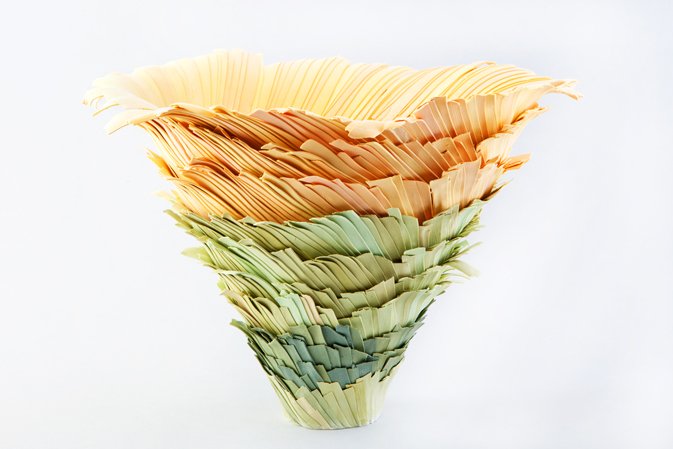 Ayala Sol Friedman, Beats | Photograph: Sasha Flit
 Ayala Sol Friedman, Beats | Photograph: Sasha Flit
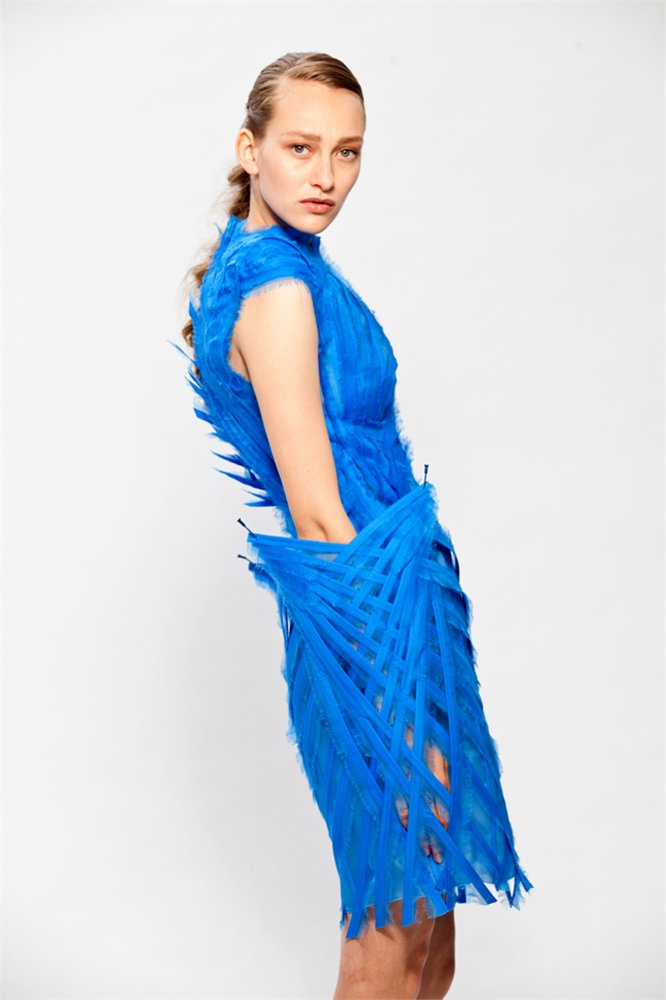
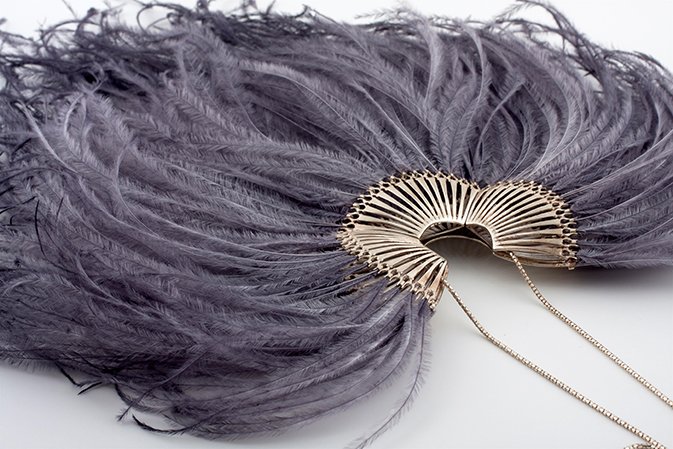
Strips also feature in the project by Hila Lantner, a graduate of the Department of Design at the Kibbutzim College of Education. Lantner created a series of body accessories designed to be worn around the neck, and which are made of PVC pipes. She chose to leave the pipes in their raw color, but manages to evoke interest with the diverse forms and uses she makes of them.
 Transitions, Hila Lantner | Photograph: Dror Ben NaftaliIn one of her pieces Lantner has cut the pipes to obtain very thin strips, which she shapes into a kind of plastic waterfall around the neck and body. This piece manages to extract unexpected striking qualities of delicateness and texture from the colorless and nondescript material, whose design is reminiscent of the feathered collar around an eagle’s neck.
 Transitions, Hila Lantner | Photograph: Dror Ben Naftali
Although the different fields of design are still studied separately, it seems that despite this separation quite a few of this year’s graduation projects communicate with one another. A broad view of the various fields of design manages to surprise and accords added value to the various projects, especially at a time when it is so easy to shift from working in one field of design to another. Perhaps in the future we will see interesting inter-departmental collaborations that will bring together students with different worldviews, techniques, and work methods who will create innovations and products that have never been seen before.